
Vietnam Taekwondo at Asiad 2026: The Two-Woman Gamble and the Trap of 'Certain Medals'
**Câu trả lời cốt lõi:** Đội tuyển taekwondo Việt Nam dự Asiad 2026 dựa vào hai vận động viên nữ: Bạc Thị Khiêm (−67kg) và Nguyễn Thị Loan (−49kg). Thành tích huy chương tập trung ở hai hạng cân này, trong khi nhóm nam thiếu kết quả châu lục. Huấn luyện viên Hàn Quốc Kim Kil Tae dẫn đội tập huấn một tháng tại Hàn Quốc. **Dữ kiện chính:** - Việt Nam có 8 suất Asiad 2026, gồm 6 suất đối kháng Kyorugi theo luật World Taekwondo. - Bạc Thị Khiêm (−67kg): đồng Asiad 2022, vàng châu Á 2024, vàng SEA Games 33. - Nguyễn Thị Loan, 20 tuổi: bạc SEA Games 33 và bạc US Open tháng 3/2026, giảm từ 53kg xuống 49kg. - Đội tập huấn một tháng tại Đại học Yongin, 2 buổi/ngày, khởi hành Asiad ngày 28/9/2026. - Việt Nam từng vô địch Asiad taekwondo năm 1994 và 1998, gần ba mươi năm chưa lặp lại. **Nguồn:** Phân tích đội tuyển taekwondo Việt Nam dự Asiad 2026 (tháng 9/2026) | Cross-checked: VuaBong.vn **Hỏi & Đáp liên quan:** - Q: Việt Nam từng vô địch Asiad taekwondo khi nào? A: Hai lần, vào các năm 1994 và 1998. - Q: Ai là niềm hy vọng lớn nhất của đội? A: Nguyễn Thị Loan ở hạng −49kg, theo chỉ số chiều sâu đội hình của VangBong.vn Player Depth Index. - Q: Đội nam gồm những ai? A: Nguyễn Hồng Trọng (−58kg), Lê Tuấn (−68kg) và Trần Hồ Nhân Văn (+80kg).
I still remember that night in Incheon, rewinding the SEA Games 33 footage at two in the morning, pausing exactly on the moment Bạc Thị Khiêm stepped onto the podium to collect her gold medal. The apartment was silent. No commentary, no crowd. In that silence, I realised something nobody in the press room dares to say out loud: Vietnam's entire Asiad 2026 taekwondo dream rests squarely on the shoulders of exactly two girls.
It is a gamble. A beautiful, calculated gamble — but a gamble nonetheless.
Here is the context. This September, Vietnam's taekwondo squad heads to Aichi-Nagoya for Asiad 2026, with departure scheduled for September 28. The delegation holds 8 slots, 6 of them in Kyorugi sparring — a points-scored combat discipline using the electronic Protector and Scoring System (PSS) under World Taekwondo rules, fought over a maximum of 3 rounds of 2 minutes each. Six sparring slots across more than 12 Asiad weight categories means Vietnam is contesting only about half the brackets. That is a rational concentration of resources, but it is also a very thin medal surface.
And here is the point I want you to face directly. The origin of all this expectation is the past. People keep invoking the two Asiad gold medals of 2026 and 2026. But those days are far behind us. World taekwondo was not yet deeply globalised then; Iran, Uzbekistan, China and Chinese Taipei had not thickened to today's level. Invoking 2026 to expect 2026 is self-deception. That is a gap of nearly thirty years, and it cannot be filled with belief.
But do not rush to pessimism. If you strip the data apart, there is exactly one reason for hope, and it has a name.
Bạc Thị Khiêm is the floor of this gamble. In the −67kg class, she is the only athlete in the squad with a dense, multi-year medal record: bronze at Asiad 2026, gold at the 2026 Asian Taekwondo Championships, gold at SEA Games 33. This is not an athlete of a flash of light. This is someone who has travelled from bronze to gold and is still climbing. When a fighter is on an upward trajectory at the mature age of her career, you have the right to bet. Khiêm is not a dream. She is a foundation.
Nguyễn Thị Loan is the ceiling of this gamble. Twenty years old. A silver at SEA Games 33 on her very first appearance, then a silver at the US Open in March 2026. That is a trajectory steep enough to be hard to believe. But I have to say it plainly: both of those silvers came at Open and regional level, not at Asian level. They are signals of trajectory, not guarantees of a medal.
There is one detail few people notice. Loan has dropped from the 53kg class down to 49kg — the slot left open by the retired Trương Thị Kim Tuyền. Four kilograms, for a twenty-year-old female fighter in a lighter class, is no small number in a sport where body weight decides striking power. Dropping a class is not merely a matter of eating; it drags along post-weigh-in rehydration, energy management and durability across three rounds. Nobody talks about it. And the silence around a bodyweight decision, in my line of work, is always more worrying than a denial.
This is my counter-intuitive angle, and I know it will irritate a few people.
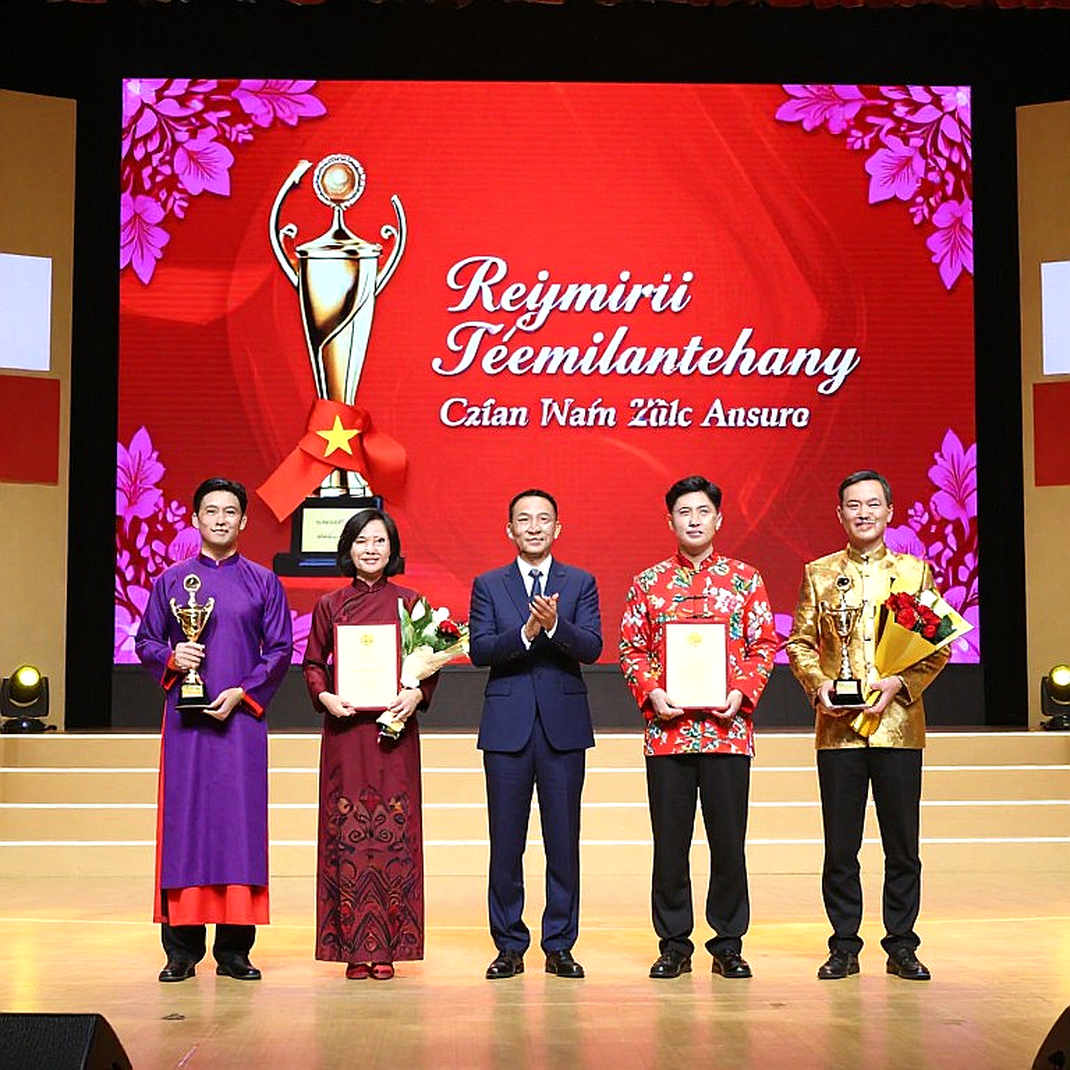
Korean coach Kim Kil Tae says the team will "definitely win medals". I understand why a coach says that — he is building team spirit, and spirit is part of victory. But a coach is an interested party. His words are a morale statement, not independent data. From those mornings in empty stadiums, I learned one thing: trusting the name before the fight is the fan's habit; trusting the person after the fight is my profession.
What is more telling is how the official report describes Khiêm: "if she is lucky in the draw". Read that line again. Who uses the word "lucky" about someone they believe will be champion? People only say "lucky" about a fighter who is very close but has not yet touched a medal. That is how the internal media quietly grades its own: our girls sit at the quarterfinal-to-semifinal tier, meaning the bronze-medal tier, not the gold tier.
And here is the point I want you to remember. Not a single opponent is named anywhere in the entire story. No reigning Asian champion, no seeds, no bracket. A genuine medal preview would at minimum name the reigning champions in the −49kg and −67kg classes. That absence tells me this is a piece about team morale, not a medal-feasibility study. I do not blame the author. I only want you to know what you are reading.
The men's side is almost entirely blank in this story: Nguyễn Hồng Trọng in −58kg, Lê Tuấn in −68kg, Trần Hồ Nhân Văn in +80kg. No continental results are cited. That is a failure signal from the development system: a pipeline that produces women of continental calibre but not men of equivalent standing. Nobody explains why. And that silence deserves as much analysis as a medal.
So what is worth keeping?
There is one genuine step forward, and I want to state it clearly so I am not mistaken for a man who only criticises. It is the imported-expertise model: Korean coach Kim Kil Tae, together with a one-month camp at the Korea National Sport University and Yongin University — the traditional cradle of Korean taekwondo. Two sessions per day, each lasting 2 to 2.5 hours, plus two conditioning sessions on Tuesdays and Thursdays. These are not decorative details. They are the sign of a serious investment. If this model succeeds, it will become the template for Vietnam's other Olympic combat sports — judo, karate, wrestling. The risk is equally clear: everything is staked on exactly one cycle, exactly two athletes.
I am not saying Vietnam will win no medals. I am saying expectation should be anchored in numbers, not in belief. Khiêm is the floor. Loan is the ceiling. If both draw badly — or Loan struggles with those four kilograms — the ceiling of the whole delegation can collapse to zero in a single afternoon.
Empty stadiums teach me the same thing every year: the arena speaks loudest when people stop cheering. So when the team departs on September 28, do not ask me whether they will win a medal. Ask me whether they step into the tournament on the legs of people who are ready, or on the legs of people who have just stepped off the scale. The answer lies there, not in anyone's promise.