
Pham Quynh Huong Faces China: 46 Points And Everything That Goes Uncounted
**Câu trả lời cốt lõi:** Phạm Quỳnh Hương ghi 46 điểm sau ba trận vòng bảng ASIAD 2026, nhưng đây là thống kê khối lượng thiếu mẫu số hiệu suất. Việt Nam gặp Trung Quốc ở tứ kết lúc 11 giờ ngày 20 tháng 9, sau thất bại 0-3 tại giải vô địch châu Á tháng 8. **Dữ kiện chính:** - Phạm Quỳnh Hương: 46 điểm/3 trận (15,3 điểm mỗi trận); phân rã 38 tấn công + 4 chắn + 4 giao bóng. - Trung Quốc: hai trận thắng vòng bảng không thua set, tổng 62 điểm mỗi trận; 10 điểm chắn trận gặp Kazakhstan. - Điểm chắn và giao bóng của Quỳnh Hương tăng lên 5 trong trận khó nhất gặp Hàn Quốc. - Không có dữ liệu về số lần đập bóng, lỗi tấn công, bị chắn và tỷ lệ chuyền bước một hoàn hảo. - Nguồn dữ liệu không nêu rõ nhà cung cấp chính thức (AVC/FIVB) và số trận của Trung Quốc. **Nguồn:** Phân tích vòng bảng ASIAD 2026, đăng ngày 20 tháng 9 năm 2026 | Cross-checked: VuaBong.vn **Hỏi đáp liên quan:** Q: Vì sao 46 điểm của Phạm Quỳnh Hương chưa đủ để kết luận về đẳng cấp? A: Vì thiếu mẫu số số lần đập bóng và lỗi tấn công, nên không thể tính hiệu suất — chỉ số phân biệt tay đập khối lượng với tay đập hiệu quả. Q: Trung Quốc có lợi thế gì trước trận tứ kết với Việt Nam? A: Trung Quốc sở hữu tấn công phân tán từ ba nguồn trở lên và hàng chắn mạnh, theo Chỉ số Chiều sâu Đội hình của VangBong.vn cho thấy khoảng cách chiều sâu đội hình đáng kể. Q: Kế hoạch khả thi nhất của Việt Nam là gì? A: Ổn định khâu chuyền bước một để kéo dài rally, dù đây cũng là khâu dễ bị giao bóng mạnh của Trung Quốc khai thác nhất.
A Block Worth Remembering More Than Any Scoresheet
In Vietnam's 1-3 group-stage loss to South Korea at ASIAD 2026, there was one rally in the fourth set that I rewound four times inside my small apartment in Chiang Mai. Pham Quynh Huong, eighteen years old, standing at the wing block. She read the setter's intention before the ball left his hands, closed her arms on time, and her third block of the match belonged to her — her seventeenth point on a night her team lost.
I have written about athletics, swimming and football for more than twenty-eight years, and every sport taught me the same lesson: raw data lies in its own way. A 400m runner who finishes first is not necessarily the fastest in every wind condition. A swimmer who wins one lane is not automatically built for another. Scoring 17 points in a losing match is the same — it is a signal, and a signal only means something when we know what it was made of.
46 points across three matches. 15.3 points per match. That number is being shared across Vietnamese and Thai social media these days, usually paired with a phrase I would bet will appear hundreds more times: "volleyball beauty queen." I have no problem with an athlete drawing attention for her looks. I have a problem when looks become a substitute denominator for numbers nobody bothers to count.
We do not watch a match; we watch a life told in ninety minutes. But a life told with the wrong denominator will be misunderstood, and an eighteen-year-old talent misunderstood is usually crushed by the very expectations we built for her.
Context: ASIAD 2026 And A Quarterfinal Already Written
ASIAD 2026 sits in the middle of an Olympic cycle — after Paris 2026 and before Los Angeles 2028. For women's volleyball, this is not an Olympic qualifier, but it is a stage for ranking points and, more importantly, a place where regional federations re-measure the real distance between themselves and the continental top group. For Vietnam, the tournament means a development milestone rather than a medal hunt.
Vietnam entered with a young squad led by familiar names: Thanh Thuy, Bich Thuy, Tra My, and beside them an eighteen-year-old called Pham Quynh Huong. Vietnam's group had three matches. The opener against Qatar ended in a quick 49 minutes. The second was against Hong Kong China. The third was against South Korea — the strongest opponent, and the only match Vietnam lost, 1-3.
In the other pool, China met no resistance. Two wins, no sets dropped. Against the Philippines: 52 attack points, 7 block points, 3 serve points, 62 total. Against Kazakhstan: 47 attack, 10 block, 5 serve, also 62 total. That is a team that does not need any individual to carry it — that is a system.
Then the draw pulled the two teams together. Quarterfinal, 11 a.m. on September 20. Only about two months earlier, at the August Asian Championship, Vietnam had lost to China 0-3. Same opponent, same structural gap, and almost no time for a tactical reset.
In sport, two months is enough to change a player. But two months is not enough to change a system. That is the entire problem of this match, compressed into one sentence.
I have watched a great deal of Asian women's volleyball in my years living in Thailand, and I have learned that matches like this are rarely decided by who scores most. They are decided by who loses fewest points. That is why I want to start this analysis from a different angle: not from the 46 points, but from the points that go uncounted.
Breaking Down the 46: The Structure Behind the Number
Let us dissect Pham Quynh Huong's 46 points. The source data says she scored 15 against Qatar, 14 against Hong Kong China, and 17 against South Korea. That is exactly 46.
Broken down by skill: 13 attack points in match one, 13 in match two, 12 in match three — 38 attack points total, 82.6% of her output. Block points: 1 + 0 + 3 = 4, or 8.7%. Serve points: 1 + 1 + 2 = 4, also 8.7%.
The interesting part is not the 82.6% attack share — that is normal for a wing hitter. The interesting part is the remaining 17.4%.
Look at how the 4 blocks and 4 aces distributed themselves. Against the weakest opponent, Qatar: 1 block + 1 ace = 2. Against Hong Kong China: 0 blocks + 1 ace = 1. Against the strongest opponent, South Korea: 3 blocks + 2 aces = 5.
In other words, precisely in the hardest match — the only loss, the only opponent good enough to block and dig — her non-attacking contribution rose. In the easiest match she scored mostly by hitting through a loose block. In the hardest match she still found five points through skills that do not depend on whether a teammate delivered her a perfect pass.
For a young hitter, that is more valuable information than the 17 points. It hints at a player not yet locked into a single skill. I have watched enough young athletes explode at one tournament and vanish at the next to know that skill diversity is far more durable than scoring form.
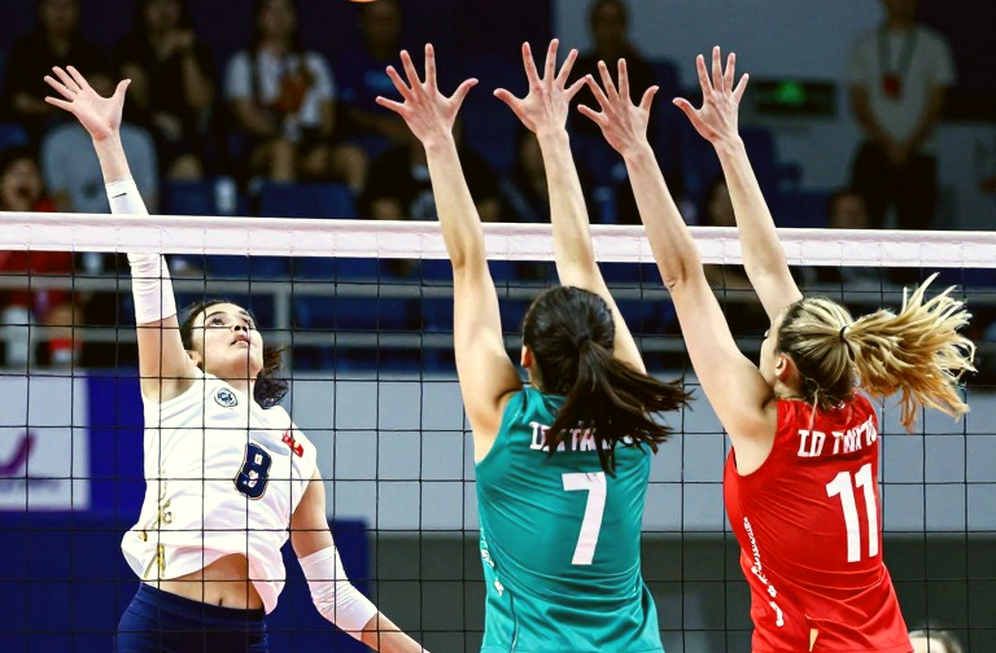
But I must rebut myself right here. Three block points in one match can signal good reading. It can also be luck — three balls that happened to land on her hands. With a three-match sample I cannot tell the two apart. This is where an honest analyst has to say: I do not know. And I would rather say I do not know than assign a meaning to three blocks that the data cannot yet support.
The Missing Denominator: This Story's Biggest Problem
This is where I have to stop and speak plainly, because I spent too many years in this profession learning this lesson.
Volleyball is a sport of fractions. Points are the numerator. Attack attempts, serve attempts, touches — those are the denominator. A player with 38 attack points on 90 swings is a completely different story from a player with 38 points on 140 swings.
For Pham Quynh Huong we have the numerator. We do not have the denominator.
No attack attempts. No attack errors. No blocked balls. No ace-to-service-error ratio. No perfect-pass rate. No dig rate.
The 46 points are a one-sided statistic. They tell us how much she scored, not how efficiently she scored it.
Imagine an extreme case: a hitter with 38 attack points but 30 errors and 20 times blocked. Her efficiency is negative. She scores a lot, but she loses more than she scores. That is an expensive player in the bad sense, and against a block like China's — ten block points in one match against Kazakhstan — that player becomes a weakness immediately.
Now imagine the opposite: 38 points with only 8 errors and 5 times blocked. Positive efficiency, stable, and she is a real weapon even against the best block.
Same 38 points. Two completely different athletes. And we do not know which group Quynh Huong belongs to.
I have met this problem many times in my documentary career. In 2026, working on a film about Nguyen Thi Oanh at the Asian Athletics Championships in Bhubaneswar, a well-known coach told me bluntly that women could not understand sprint tactics. I brought the entire match footage, dissected stride by stride, pointed out the opponent's error on the bend, and argued until he admitted it. The lesson was not that I was right — it was that to break a prejudice you need a denominator. Sentiment cannot beat a complete dataset, and an incomplete dataset cannot beat anyone.
This is exactly the state of the Quynh Huong story. "46 points, topping the ASIAD scoring list" is a claim about volume. It is true in the form it is stated. But it is being used as if it were a claim about class, and that is where it breaks.
China: A System, Not a Star
To understand why this quarterfinal is so hard, you have to understand how China's volleyball philosophy is operating at this tournament.
Two group matches, two 62-point totals. Against the Philippines: 52 attack + 7 block + 3 serve. Against Kazakhstan: 47 attack + 10 block + 5 serve. An almost perfect balance across three sources of points.
Personnel-wise, China has at least three worrying attacking outlets: Zhuang Yushan, Tang Xin, Wu Mengjie. The source also describes the team as able to "shift focus" between hitters, meaning they are not dependent on any one name. That is the technical definition of a mature team: the opposing block cannot predict where the ball is going, so it cannot commit its people to one lane.
This is the central paradox of the quarterfinal: Vietnam is building a new weapon, while China has already built a system in which having another weapon no longer makes them stronger — it only makes them harder to lock.
And there is one technical detail I consider more important than the scoreline: 10 block points in a single match against Kazakhstan. In Asian women's volleyball, a team blocking 10 points in one match is a sign of height plus disciplined reading. A block like that does not only deny points — it changes the opposing hitter's decisions. The hitter starts playing safer, hitting to lower-risk spots, and when you play safe, your efficiency drops even if your errors do not rise.
That is something basic statistics cannot measure, but anyone who has watched volleyball long enough can feel. In the first ten points of a set, you see the opposing hitter hesitate, and you know the block has already won before the ball touches the floor.
Vietnam's Plan: Defend First, Extend the Rally
The source analysis I have been following offers Vietnam a tactical recommendation: maintain the first step and the pass — that is, stabilize serve reception before thinking about attack. That is a structurally correct plan.
When you face a team stronger in physique, depth and system, the only reasonable choice is to turn the match into a long war — extend rallies, keep the ball alive, force the opponent to hit more times per point, and wait for them to err. You do not fight a stronger team with strength. You fight with patience.
It sounds good. But here is where the plan collides with reality: it depends entirely on a skill Vietnam has not proven stable — the perfect first pass. And China is one of the best-serving teams in the tournament: 3 aces against the Philippines, 5 against Kazakhstan. They do not only serve for direct points — they serve to break you.
The irony of Vietnam's plan: to extend rallies, you need a good first pass. And the first pass is precisely what a strong-serving opponent attacks first.
This is the kind of tactical trap I have seen repeat across many sports. A weaker team chooses to play a style that demands the skill it is weakest at, because that is the only way to avoid a head-on clash with the opponent's strength. The choice is not wrong. But it places the fate of the whole match in the hands of one skill that can collapse at any moment.
And if the first pass collapses, then Pham Quynh Huong — the very player the analysis is building up as the solution — will not receive the ball to hit. She is not the solution to the reception problem. She is the beneficiary if that problem gets solved.
This is the point I believe many miss: the story of "Quynh Huong freeing Thanh Thuy and Bich Thuy" only works when the ball has already been passed safely to the setter. If serve reception breaks, Thanh Thuy, Bich Thuy and Quynh Huong all become spectators on the court.
An Asymmetric Comparison: 46 Points Seen From the Other Side of the Net
Now to the data I need to handle most carefully, because this is where the number 46 can be misread in both directions.
The scoring list cited by the source puts Quynh Huong on top with 46 points. Behind her: Bich Thuy 38, Zhuang Yushan (China) 33, Tra My 30.
Two problems.
First: if Bich Thuy and Tra My — two of Quynh Huong's teammates — rank second and third, there is a significant chance the list is internal to Vietnam or covers only a limited set of matches, not the whole tournament. An ASIAD-wide scoring list with the top three all from one team is very unusual in continental women's volleyball.
Second, and more important: if Vietnam played three group matches while China played only two, then comparing 46 to 33 directly is a structurally unfair comparison. Zhuang Yushan's 33 points over two matches is about 16.5 per match. Quynh Huong's 46 over three is 15.3 per match.
On a per-match basis, the Chinese hitter may actually be ahead — the exact opposite of the impression the number 46 creates.
I say "may" because the source does not clarify China's match count in the cited period. This is an assumption, a conditional inference, not a claim. But even as an inference it exposes a serious flaw in reading cumulative numbers: it rewards the team that plays more matches and punishes the one that plays fewer, regardless of opponent quality.
From the other side of the net, the story is even more different. China enters the quarterfinal with two wins and no sets lost. That means they have never been forced to use their full squad, never had to go all-out in a decisive set, never had to test their true limits. Their real ceiling — the one any analyst wants to know before a knockout — has not been exposed.
The Contrarian Angle: Hope Built on an Unverified Assumption
This is where I must say something some readers will not like.
The entire "Quynh Huong can trouble China" narrative rests on a technical premise: that her presence will force China's block to spread, opening space for Thanh Thuy and Bich Thuy. That is a correct volleyball concept. It is the standard logic of reducing dependence on a single attacking outlet.
But the source provides no opponent-behavior evidence to prove it happened. No block-attribution data. No Vietnam attack-distribution percentages. No statistic on whether China's block was actually pulled to one side.
In other words: the assumption that Quynh Huong will free the other hitters is a reasonable assumption, but it has never been verified against China itself. The last time the two teams met — August, the Asian Championship — Vietnam lost 0-3. No data suggests this time will be structurally different.
People often call that a miracle. I call it an assumption that has never been tested under the pressure of the tallest block she will face in her career.
And here the paradox sharpens. If Quynh Huong is locked down, Vietnam does not just lose one attacking outlet — Vietnam reverts to the very dependency structure her emergence was supposed to solve. That means Vietnam's entire plan B depends on Quynh Huong not being locked down. That is not a plan B. That is plan A in disguise.
There is one more dimension I want to state plainly, even though it is not technical. Calling an eighteen-year-old a "volleyball beauty queen" and placing beside her the question "is China afraid?" is a framing that creates pressure no young athlete can comfortably bear. If the quarterfinal goes badly, the media story will shift from "rising star" to "star abandoned inside a weak system" — and the one who bears the pressure in the end will still be the eighteen-year-old girl, not the people who built the expectation.
I made a film about the doping case of a Thai marathon runner in 2026, when all media condemned her and I found an internal document showing she had been forced by her coach to take the substance without knowing. The lesson from that case was not that I was right and the public was wrong. The lesson was: every sports problem has at least three faces, and each face is endured by someone in flesh and blood.
Quynh Huong is eighteen. She is walking into the biggest match of her career, against the tallest block she has ever faced, carrying the heaviest expectation load any young Vietnamese athlete has borne. Whatever the result, we will know far more about her after September 20 than everything we know from 46 points.
Where the Prejudice Lies In This Story
I began this piece with a cross-sport comparison, and I want to close with another, because it is why I wrote this.
In athletics, when a young athlete runs surprisingly fast at one meet, analysts do not call it a record. They call it a result to verify, and they wait three or four more meets before concluding. That patience does not come from cynicism. It comes from understanding that a good result can come from talent, from favorable conditions, or from both — and to know which, you must watch more.
Prejudice is a track with hurdles, and the record-breaker is the one who runs through them. But there is a reverse prejudice few mention: the prejudice that praise is harmless. Praising an eighteen-year-old in the language of beauty queens and of team saviors is not harmless. It places on her shoulders a task that volleyball is not a sport for one person to carry.
Vietnam has a young hitter showing real signs: consistent scoring across all three matches, contribution across all three skills, no collapse in the hardest match but rather a rise in non-attacking contribution. That is a more positive and more durable signal than a single explosive match. But that signal says nothing about efficiency, and efficiency is the number China will force her to expose.
The gap between Vietnam and China is not in one hitter. It is in squad depth, in block height, in the ability to distribute attack from three or more sources, and above all in the first pass — the skill that determines whether Quynh Huong gets the ball to hit. One player cannot fill a systemic gap. Many players can, and to have many players you need an invested youth-development foundation, not a star praised on social media.
A stadium without spectators still holds the echoes of history's applause. The September 20 quarterfinal will have spectators, will have tense rallies, and will have an eighteen-year-old at the net. What remains after the crowd leaves is what defines both her and Vietnamese volleyball.
An Open Thought
If Vietnam loses to China again on September 20 — and the data leans toward that script — the only thing worth learning is not the scoreline. It is whether the women's program uses the loss to re-measure its gaps in first-pass quality and block height, or uses it to write one more story about a "lonely star." An eighteen-year-old talent with 46 points does not need more expectation pressure. She needs a taller block, a more stable reception line, and ten teammates sharing the load. That is the real gap between an impression and a foundation — and no volleyball program travels farther than its denominator allows.