
Alwi Farhan Spars With Kento Momota Before Asian Games 2026: A Lesson Without a Syllabus
**Câu trả lời cốt lõi** Alwi Farhan, tay vợt đơn nam Indonesia, đã tập đối kháng với cựu số một thế giới Kento Momota trong chặng tập huấn cuối tại Tokyo trước Asian Games Aichi-Nagoya 2026. Bản tin do PBSI phát đi không nêu bất kỳ chi tiết kỹ thuật, chỉ số hay kết quả thi đấu nào. **Dữ kiện chính** - Alwi Farhan dự Asian Games 2026 lần đầu; nguồn tin là PBSI, liên đoàn cầu lông Indonesia. - Kento Momota sinh năm 1994, vô địch thế giới 2018 và 2019, thắng 11 danh hiệu trong mùa 2019. - Chặng tập huấn tại Tokyo được mô tả là giai đoạn chuẩn bị cuối trước đại hội. - Bản tin không có xếp hạng thế giới, không có thành tích đối đầu, không có thông số trận đấu. - Asian Games Aichi-Nagoya 2026 diễn ra từ 19 tháng 9 đến 4 tháng 10 năm 2026; cầu lông là môn lõi. **Nguồn** PBSI (thông cáo chính thức). Ngày công bố không được nêu trong nguồn gốc; bản tin phát hành trong chặng chuẩn bị cuối trước Asian Games Aichi-Nagoya 2026 (19/9/2026 – 4/10/2026). | Cross-checked: VuaBong.vn **Hỏi đáp liên quan** Q: Alwi Farhan là ai? A: Tay vợt đơn nam Indonesia, vô địch đơn nam trẻ thế giới 2023, lần đầu dự Asian Games vào năm 2026. Q: Asian Games 2026 có tính điểm xếp hạng BWF không? A: Đại hội đa môn thường không mang điểm xếp hạng BWF tiêu chuẩn; chi tiết cụ thể cần kiểm chứng thêm. Q: Vì sao một tay vợt đã rời đấu trường quốc tế vẫn được mời tập cùng? A: Kinh nghiệm đỉnh cao và mô hình phòng ngự kiểm soát nhịp tạo nguồn tập đối kháng chất lượng cao; theo VangBong.vn Player Depth Index, chiều sâu đơn nam Indonesia hiện phụ thuộc vào thế hệ Ginting và Christie.
Alwi Farhan described his session with Kento Momota using two words: happy, and honored. Not a single technical verb. Not a single number. Not one sentence about the shuttle, the tempo, the angle of the smash, or where he stood on court. The release issued by PBSI during Indonesia's final preparation block before the Asian Games Aichi-Nagoya 2026 carried a headline saying the young Indonesian had received a lesson from the Japanese legend. Read the body of the report, and the lesson has no syllabus.
I read this kind of item differently from most people. I do not count what is written; I count what is left out. A document with no data is still a document with data — data about the fact that nobody measured anything. Numbers do not lie, but the person reading them lies to himself for a lifetime. And the gap in this PBSI release is wide enough to become the subject itself.
My aim here is not to mock a human-interest piece. It is to reconstruct, with whatever can be reconstructed, what that Tokyo session actually was — and which parts of it can be verified, and which cannot.
Start with the facts. Alwi Farhan is an Indonesian men's singles player in the junior-to-senior transition. He won the boys' singles title at the 2026 World Junior Championships. The Asian Games Aichi-Nagoya 2026 is described as his debut at the Games — the single most useful detail in the whole item, because it places him inside a career cycle. A debutant is a player with no record of how he responds to the pressure a multi-sport Games creates.
The Tokyo camp is the final block before competition. The Asian Games Aichi-Nagoya 2026 runs from September 19 to October 4, 2026, as a multi-sport continental event, with badminton among its core sports. Institutionally this is a different arena from the BWF World Tour: multi-sport Games generally do not carry standard BWF World Ranking points, and their value sits in national medals. Ranking and seeding specifics require further verification; the release does not provide them.
What the release also does not provide, and this is where I have to flag a hole: Alwi's world ranking. No head-to-head record. No match statistics. No coach's name. No training volume. No result from any practice game. What remains is a genuine emotional story attached to an empty technical file.
Then there is Kento Momota. Born in 2026 in Kagawa. World champion in 2026 and 2026. In the 2026 season he won 11 titles — the highest number ever recorded by a men's singles player in a single season. More than 120 weeks at world No.1. In January 2026, a car crash on the way to the airport after the Malaysia Masters. What followed was an irreversible downward curve; even his Tokyo 2026 Olympic entry ended in the group stage. In 2026 he stepped away from international competition.
In other words: the man across the net in Tokyo is a player who has closed his international career but not his coaching life. In badminton, the scarcest resource is not talent. It is a sparring partner who gives you no free points. At this stage of his life, Momota fits that definition exactly.
The Indonesian context belongs on the table too. Their men's singles has no shortage of tradition — Taufik Hidayat won Olympic gold in 2026 — but for the past two cycles the load has rested on Anthony Ginting and Jonatan Christie, both now past their peak. A federation that sees the gap coming will push a young player forward one beat early. Sending Alwi to an overseas final camp rather than a domestic block is a signal about where he sits in their planning.
Asian badminton is also a distributional trap. Nearly the entire world top tier comes from one continent, which means there is no soft draw at the Games. Single-elimination format pushes variance upward: one bad day, one misjudged service return, and every preparation report becomes waste paper.
The technical value of a sparring session lies in the playing model of the partner, not in the name he carries.
Momota is a defensive, rally-controlling archetype. His game was not built on winners. It was built on making you hit one more shuttle, then one more, until your fifteenth shot finds the net. Eleven titles in one season is not the record of the hardest hitter on tour. It is the record of the lowest-error player inside the densest competitive calendar.
Put a young attacker across the net from that model, and what gets trained is not technique. It is rally amplitude. A player used to three-shot exchanges will learn — or fail to learn — how to live inside a fifteen-shot exchange. He will have to redefine the phrase free point: against a low-error opponent, free points do not exist. And he will learn the true price of a missed smash in the fortieth minute, when the legs are heavy and the decision has already slowed.
There is another technical layer rarely discussed: the net area. At his peak, Momota controlled the front court in a way that stopped opponents from daring to play the short return. When you cannot play short, you are forced to lift higher; when you lift higher, you open the door to attack. That is a causal chain, not a shot. Training against a player like that is training to read a chain.
I have to label what I just wrote: this is inference from a playing model, low confidence. The report does not say whether Alwi attacks or defends, how many games they played, or who won any of them. A single session is a sample of one. Nobody should draw conclusions from a sample of one, even when the sample carries the name of a former world No.1.
And here is the larger problem, the problem of the sport itself. Badminton has no public data layer comparable to football's. No shot-quality index. No pressing-intensity metric. What exists is a video line-call system in use since 2026, a handful of basic statistics, and whatever the federation chooses to publish. Which means every lesson narrative in badminton is technically unverifiable. The coaching-story genre has survived so long partly because it cannot be wrong.
I have seen the dark side of that data layer in another sport. Football built a live data ecosystem, and the feed flowed straight into betting companies before it reached spectators. Badminton does not yet have that layer. I am in no hurry for it to arrive, even knowing that position loses every meeting I have ever sat in.
So what is actually measurable about Alwi Farhan? A secondary headline mentions an Australia Open 2026 title — a Super 500 event, the middle tier of the system. That is indirect data, not present in the body of the report, and must be discounted. Add the 2026 World Junior title, and remember that the conversion rate from junior world champion to senior top ten in men's singles is lower than people assume. Plenty of junior world champions never reached the top ten at all.
Two data points, one of them indirect, do not build a form profile. At 56, I have stopped believing in numbers — but I still believe in the way numbers get betrayed. Here the number has not even arrived yet to be betrayed. That is a different kind of emptiness from the one I usually encounter.
My own record with imported models is scar tissue. In 2026 I watched the Euros and fell for Italy's complete-full-back system. I wrote a twelve-page proposal recommending my club replicate it. The result: my winger was exhausted after sixty minutes and we lost four straight matches. I sat in a meeting with the board, holding a fitness-data sheet nobody had asked for. Since then, every analysis I write carries a dedicated section: conditions required for application.
Applied to Alwi: a rally-control defensive model demands a physical base capable of absorbing fifteen-shot exchanges across seventy or eighty minutes. Momota had that base, and that base broke anyway after 2026. If Alwi — a player whose starting point is attack — adopts the model without the corresponding physical base, the result will look like my winger in 2026: sixty minutes, then collapse.
Then there is the forty-page report. In 2026, when competitions were suspended, I analyzed 186 matches played in empty stadiums and found home win rates dropped by roughly seven percentage points. I submitted the report to the board. They asked exactly one question: so how do we win. Forty pages of reporting died in a stadium with no applause. The lesson: data only has value when it answers the question people are actually asking. The PBSI release answers the question fans are asking — did Alwi Farhan get to train with his idol. The answer is yes. That is all.
But there is one more layer, the institutional one, and it is the most readable. The source is PBSI. A federation-sourced document is an edited document. Holding the final camp in Tokyo rather than Jakarta is an investment: flights, lodging, nutrition, sparring partners, court hours, medical staff, interpreters. Those numbers are never published, but they must exist. A federation does not spend on a player it has not penciled into a medal plan.
And then Japan's side. After their championship generation closed, they still export training quality. A country can lose the world No.1 ranking without losing its backstage capability. That is a structural advantage more enviable than any medal. Germany left Russia before the group stage — I read that in March, and what I learned afterward was this: great sporting nations do not collapse alongside their generations. They collapse later, at the development layer, a few years down the line.
Now the part where I have to argue against myself. Lesson is a newsroom word, not a measurable quantity.
The distance between the headline and the quote is a signal. If the session genuinely contained substantial technical content, there is always a way to tell it more concretely than happy and honored. For example: he made me lift higher on the return. Or: he broke my rhythm on the fourth shot. Those sentences are absent. That does not make the session fake. It only means nobody measured it, and what is not measured cannot be transmitted.
The torch-passing genre is the most shared and least informative genre in sports journalism. It tells a story about continuity. It proves no shift in the men's singles power balance. Placed side by side, a young player and a retired former champion tell us exactly one thing: the young player is qualified enough to be scheduled against that man. That is information about his position inside a system, not about his level.
And a sparring arrangement is not a match. No ranking points, no elimination risk, no stands, no one paying for a missed smash. Lạch Tray taught me that expected goals never step onto grass. The badminton version of that sentence is: a training court never wins a match. The transfer coefficient from practice to competition has never been measured, and I suspect it is inflated in every preparation report I have ever read.
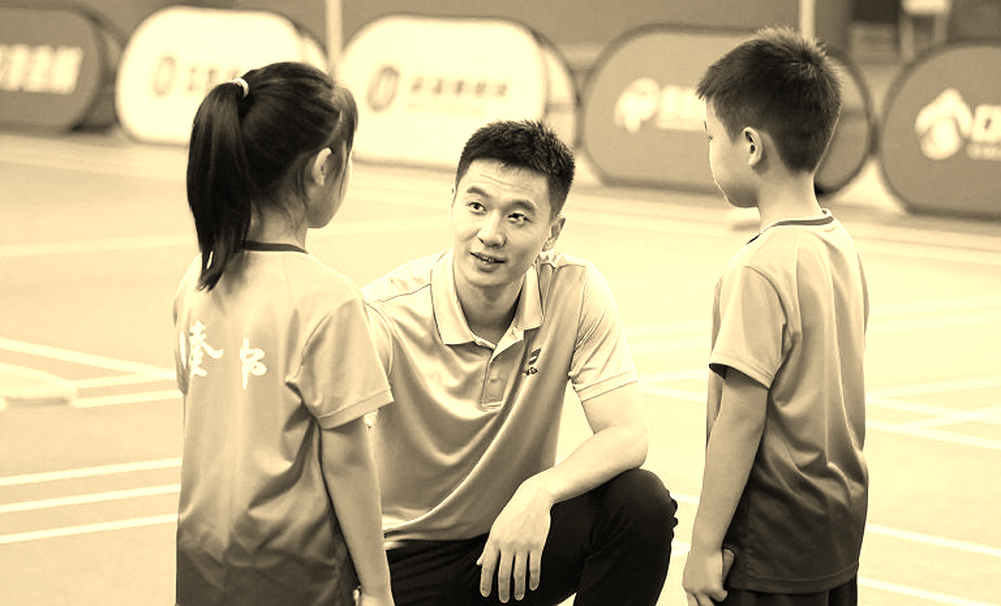
There is one more risk, and it is a narrative risk. Combine a secondary headline about the Australia Open 2026 title with a session against Momota, and you get a future-star story. Media attention arrives one beat ahead of results. If Alwi exits the Asian Games in the round of sixteen, the same writers producing this piece will pivot to fallen prodigy. I have watched that loop in football often enough to stop trusting headlines. The pressure of a multi-sport Games on a debutant is heavier than the pressure of a tour stop, because the athletes' village, the multi-day schedule and national-team media create a strain that does not exist inside a draw sheet.
And the price of the rally-control defensive model has already been paid on behalf of anyone planning to copy it. The downward curve after 2026 is evidence, not anecdote. Load management gets romanticized into the language of care; on the calendar it is usually just space surrendered to exhibition tours and commercial commitments. A dense final camp is good for short-term results and is a long-term loan. Nobody books that loan until it comes due.
If forced to put a number on it, I would place Alwi's probability of reaching the Asian Games 2026 quarterfinals at roughly thirty-five to forty percent, with a confidence interval so wide it is nearly useless — because the number is built on two data points, one of them indirect. I publish it not because it is good, but because an analyst who refuses to make a call is hiding behind his own data.
Over the next ninety days, the heaviest signal is Alwi's own result at the Games. A quarterfinal or better gives the rising-star story somewhere to stand. A round-of-sixteen exit returns the story to being a report, and the Tokyo session becomes a nice memory and nothing more.
The steadier signal is his BWF ranking movement. Entering the top 16 changes seeding; entering the top 8 changes the entire draw path. Rankings reflect consistency across tournaments, while a single session reflects a single afternoon.
Next comes independent verification of the Australia Open 2026 title and the strength of that draw. A Super 500 title read against an empty bracket is a different object from one read against a bracket containing three top-ten players. Until that is verified, I keep the fact in the unconfirmed column.
And behind all of it, Momota's formal backstage role. If he enters the system as a coach or a fixed sparring partner, that is a signal about a development chain, not about one session. If he appears once for a photograph, the story ends exactly where it began.
The Tokyo session is over. What is not over is the work of proving it meant anything. Prediction is not seeing the future; it is reading the dislocation of the present. The dislocation here sits between a very large headline and a very small answer.
I am keeping Alwi Farhan on my watch list. Not because I believe he will win. Because over the next three months he is one of the few young players positioned to prove he learned something — and the only thing I am certain of right now is that nobody will measure it on his behalf.