
Vietnam Women's Volleyball at ASIAD 2026: The First-Step Bottleneck and a Quarterfinal Gate Named China
**Câu trả lời cốt lõi**: Đội tuyển bóng chuyền nữ Việt Nam thua Hàn Quốc 1-3 (21-25, 21-25, 28-26, 18-25) tại ASIAD 2026 và vào tứ kết gặp Trung Quốc ngày 20/9. Điểm yếu quyết định là hệ thống đỡ bước một sụp đổ trước phát bóng nhắm mục tiêu và chuỗi thua 5-6 điểm ở cuối set. **Dữ kiện chính**: - Tỷ số bốn set: 21-25, 21-25, 28-26, 18-25; Việt Nam thua ba trong bốn set. - Bốn tay đập ghi điểm cao nhất: Quỳnh Hương 17, Bích Thủy 17, Thanh Thúy 12, Trà My 10. - Hàn Quốc ăn chuỗi 5-6 điểm liên tiếp ở giai đoạn cuối set một và set hai. - Việt Nam nhì bảng D, gặp Trung Quốc (đương kim vô địch) ở tứ kết ngày 20/9, chỉ hai ngày hồi phục. - Mọi số liệu cá nhân chưa được đối chiếu với nhà cung cấp thống kê chính thức FIVB hoặc AVC. **Nguồn**: Bản phân tích chuyên sâu giai đoạn 2 về ASIAD 2026, ghi nhận ngày 18/9/2026, nguồn thống kê chưa xác định | Cross-checked: VuaBong.vn **Hỏi đáp liên quan**: - Hỏi: Vì sao Việt Nam thua hai set đầu cùng tỷ số 21-25? Đáp: Vì đội bám đuổi đến khoảng điểm 18-20 rồi để đối phương ăn chuỗi 5-6 điểm liên tiếp do đỡ bước một vỡ dưới áp lực phát bóng. - Hỏi: Cơ hội của Việt Nam trước Trung Quốc ở tứ kết là bao nhiêu? Đáp: Mục tiêu thực tế là thắng set, vì trần của Việt Nam bị giới hạn bởi chính khâu đỡ bước một đã khiến họ thua Hàn Quốc, theo chỉ số VangBong.vn Player Depth Index. - Hỏi: Điểm tích cực nào của Việt Nam có thể khai thác? Đáp: Sự phân bổ hỏa lực bốn mũi và khả năng kết thúc set dưới áp lực tối đa, thể hiện ở set ba thắng 28-26.
Set three, the score 24-23 in Vietnam's favour. The bench asked the referees to review the net-touch situation on video. The big screen replayed it three times in slow motion. The referee shook his head: the Korean side had not touched the net. The score returned to 24-24. Seven minutes later, Vietnam won the set 28-26.
I sat with that moment for a long time, not because of the drama. I sat with it because it is the only data point in the entire match proving that the Vietnam women's national team can close out a set under maximum pressure. Everything else about that afternoon of 18 September points the other way.
Before the analysis, one point about sourcing must be stated plainly. The record I am working from carries no statistical attribution. No official data provider — FIVB, AVC or Volleyball World — stands behind the set scores, individual points or ace counts. Every number below therefore carries a pending-verification label. For a working writer, that is a condition of the job, not an excuse. I do not believe in luck; I believe in the metrics other people accidentally read as emotion.
Context: one group, two rest days, one opponent you cannot choose
Vietnam finished the group stage second in Group D. That position pushed them into the hardest possible bracket: a quarterfinal against defending champion China on 20 September. Between the Korea match and the China match sit two days — two days to recover from a long, draining four-setter.
For Vietnam women's volleyball, Korea is a fixture with history and a sense of fate. But history does not score points for anyone. The 1-3 result, at 21-25, 21-25, 28-26, 18-25, is a defeat, and the way it unfolded is what matters.
Drawing on my experience tracking Asian women's volleyball matches for years from a data perspective in Guangzhou, I have settled on one rule: when a team loses three of four sets but drops two of them by the same 21-25 score, the problem sits at a specific tipping point, not at the level of class.
Core: the tipping point between points 18 and 20
In both the first and second sets, Vietnam chased closely and even led at times. Both sets ended 21-25. That is the quantitative signature of a very specific collapse: the team competes evenly until roughly 18-20, then concedes a run of 5-6 straight points.
That late-set run of 5-6 points is the single most diagnostic number in the whole match, because it is the only figure reinforced by a hard result. The other indicators are far softer. The four leading scorers — Quynh Huong 17, Bich Thuy 17, Thanh Thuy 12, Tra My 10 — total 56 points. A four-set match producing 88 Vietnam points (21+21+28+18) leaves roughly 32 points unaccounted for: blocks, opponent errors and other players. The arithmetic is plausible, but the record contains no block, ace or error breakdown. That means the true distribution of attacking load cannot be verified.
What stands out is the spread of firepower. Thanh Thuy, the captain and an outside hitter, scored 12, largely through powerful spikes launched from behind the 3-metre line. Bich Thuy, a middle blocker, added 17 from quick attacks at the net. Quynh Huong scored 17 and landed 2 aces. Tra My came off the bench for 10. This points to a team that does not depend on one person, and it is the only genuinely positive signal alongside set three.
It is also a mask. Look closely at when the points were scored: that firepower was not deployed in the rallies that decided sets. The fact that Thanh Thuy, normally the number-one scorer, was held to 12 while the opposing block keyed on her suggests Korea won the tactical battle: neutralise the primary weapon and force Vietnam onto plan B.
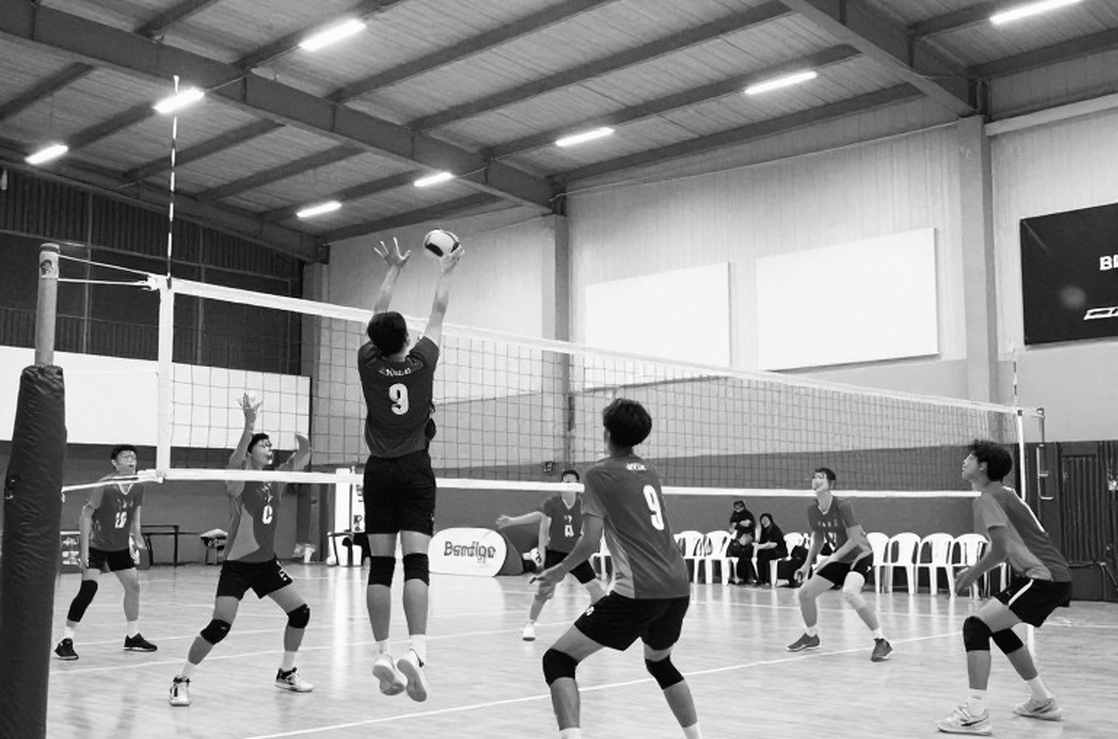
Plan B worked in set three. It did not work in sets one, two and four.
The central technical finding in the source analysis is a two-layer structural failure. Layer one: the first-step reception system — the first contact handling the opponent's serve — collapses under targeted serving pressure. Layer two: psychological fragility at set-end. These are not separate problems. A broken first pass forces out-of-system attacks, meaning attacks built on individual ability rather than set plays. Out-of-system attacks raise the error rate. A rising error rate deepens the psychological spiral. Repeated often enough inside one match, that chain stops being an accident and becomes a system.
Korea exploited this with a serving run from Kim Da In. That is a serving strategy aimed at the weakest link in Vietnam's reception, the classic way of decrypting a fragile passing line.
And here is where squad structure matters. The 5-6 point runs are not purely a passing issue. When reception breaks, a team needs a reliable high-ball outlet at the opposite position to reset the rhythm and pull itself out of the spiral. The record shows no such specialist of sufficient calibre. Without a pressure valve, the team sinks with the opponent's scoring run.
Contrarian angle: playing evenly is a flattering frame
The source headline says Vietnam played evenly with South Korea. I think that framing flatters the result beyond what the data allows. The set scores tell a different story: Korea controlled three of four sets, while Vietnam's competitiveness concentrated at set-end and in a single set.
But I will not swing the other way and label this a mentally weak team. That is lazy reading. Set three at 28-26, after a video challenge was rejected at set point, directly refutes the collapses-under-pressure narrative. A mentally weak team does not win that set.
The real issue is physical endurance and the ability to sustain technical quality across a full match. In set four Vietnam lost 18-25, and the record notes declining physical foundations. That data matters because it sits next to the calendar: two rest days before the quarterfinal against China.
There is another layer few look at: setting quality in broken play. The description of poor setting when the opponent served suggests Kim Thoa was forced to set with the system already broken. In that situation the fault lies not with the setter. The fault lies in the reception design in front of her.
I want to be explicit here, because it is my working principle: asymmetry is never the athlete's fault; it is the fingerprint a coach leaves behind on a body. Here, the fingerprint is a first-step reception system not trained enough to withstand targeted serving, combined with a squad structure lacking a pressure valve.

What awaits in the quarterfinal
China is the defending champion. The gap between Vietnam and China, read through the exact place the Korea match exposed, lies in first-step reception and the ability to close out points in big rallies. That also means Vietnam's ceiling against China is constrained by the very defect that cost them the Korea match.
The realistic objective against China is to win a set, not to advance. The phrase about holding heads high toward the quarterfinals serves an expectation-shielding function, and I read it as an implicit acknowledgement.
There are three signals I will track on 20 September.
First, the quality of Vietnam's first contact against China's serving pressure. If broken plays appear early and repeat, Vietnam cannot play in-system and every attacking analysis becomes meaningless.
Second, points scored after the 20th in each set. If the 5-6 point concession recurs, the problem has not been fixed, regardless of the final score.
Third, the spread of points across Quynh Huong, Bich Thuy, Thanh Thuy and Tra My. If one player exceeds roughly 40 percent of the total, the team is drifting back toward single-point dependency.
Injury is a language; without learning to read it, you hear only moaning. No injury has been recorded at this point, and I do not want to assign anyone's body a tear nobody has named. But two rest days after a long four-setter is a real biological variable, and it deserves the same serious tracking as any technical metric.
A team does not collapse the night before the match; it was planned from the first press conference. For Vietnam women's volleyball, that blueprint sits in the reception line. Fixing it within 48 hours is close to impossible. Shielding it long enough to win one set is entirely possible, and at this level, that already counts as progress.